
Pauline Rutter is a programme manager for Writing Our Legacy, an arts and heritage organisation enabling Black, Asian and ethnically diverse people to tell their story through writing and the creative arts. Here she writes about an initiative to explore people’s connections with water in the landscape.
For those of us lucky enough to live in Sussex near the coast, it may be that being close to a large body of water has become a fundamental part of our lives. Perhaps we take for granted that the beach is a walk or a bus ride away and have become so accustomed to gazing out across blue grey waves, that we barely notice how soothed we are by the rise and fall of the tides. Too many, however, will rarely make a visit. Do we ask why within UK deprivation statistics young people of our coastal regions continue to live on the edge and many do not have this familiarity?
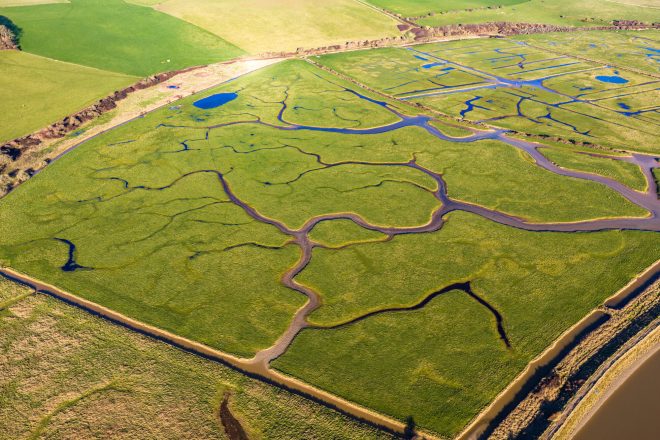
It is a privilege for some of us to be near to the Cuckmere River that meanders across the Weald or by the River Ouse with headwaters that surface on the Ashdown Forest. Then there is the River Adur, starting its journey as chalk springs to become tidal as it nears the coast, as does the River Arun that flows from the High Weald to the sea at Littlehampton. We encounter these magnificent ‘blue spaces’ of East and West Sussex in many different ways. We notice them degraded, polluted and diverted but do we ever fully contemplate the meaning of such water in our lives?
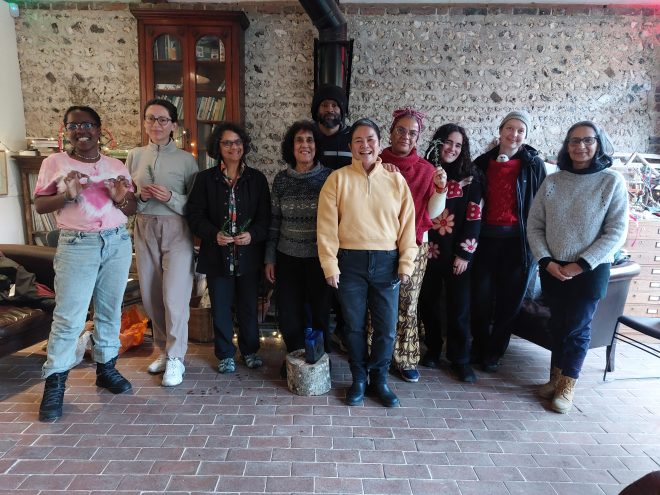
As a partner of the Downs to the Sea (DTTS) programme, Writing Our Legacy has been inviting people to be creative and speculative during a series of guided walks and writer-facilitated creative water days that are free, accessible and inclusive. Experienced and new writers alike are drawn to these events in locations where water nestles in the landscape or reaches out to the horizon from the coast. Over its fourteen years as an arts and heritage organisation, Writing Our Legacy has ensured that these experiences are inviting and accessible, especially to Black, Asian and ethnically diverse people. WOL workshops provide a warm welcome and creative connection to locations that are sometimes hard to reach. This February, a shared minibus journey to RSPB Pulborough Brooks brought WOL’s bursary and commissioned DTTS artists and facilitators to experience the flooded wetlands as signs of spring began to appear. Their imaginative new creative work evoking connections to water in people’s lives will be shared later in 2026.
Inspired by Shoreham Nature Reserve
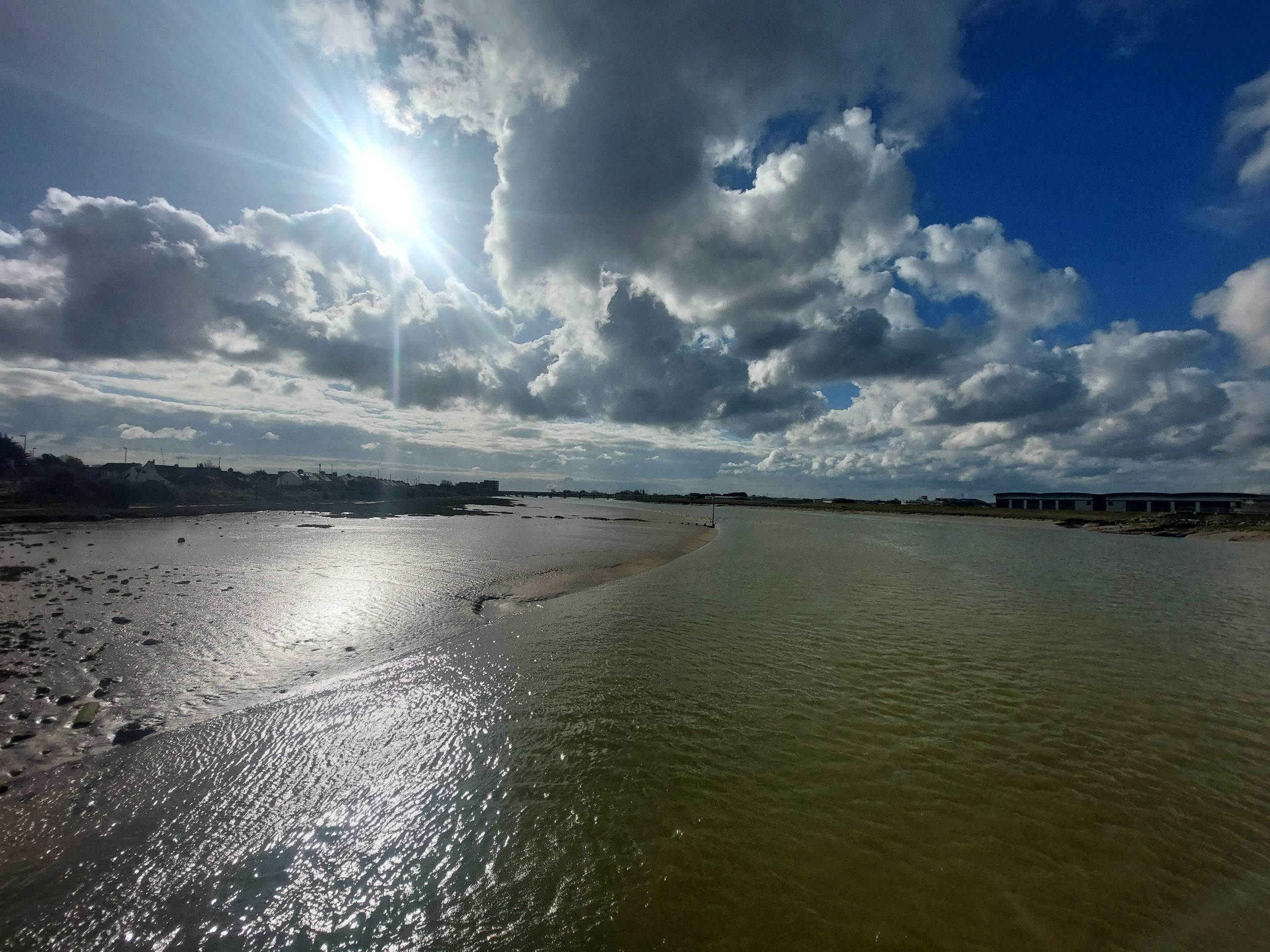
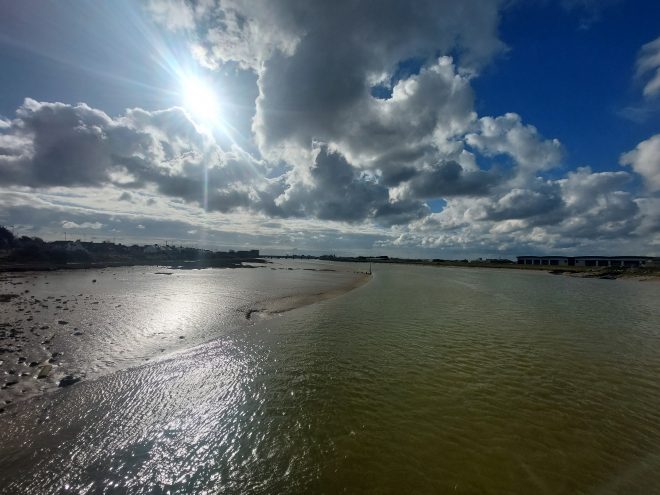
In March 2025, a guided walk to Shoreham Nature Reserve crossed the bridge over the River Adur Estuary, where wading birds were feeding at low tide. This rare and fragile habitat of beach flowers not yet in bloom, land herbs and other plants inspired conversations. What of the sensitivity of this environment to pollution, disturbance and construction? How would our shared snippets of botanical and ornithological knowledge help us connect with care and humility to the wildlife, the land, the river and the sea? What might our senses tell us when we are still and open to nature in all its complexity?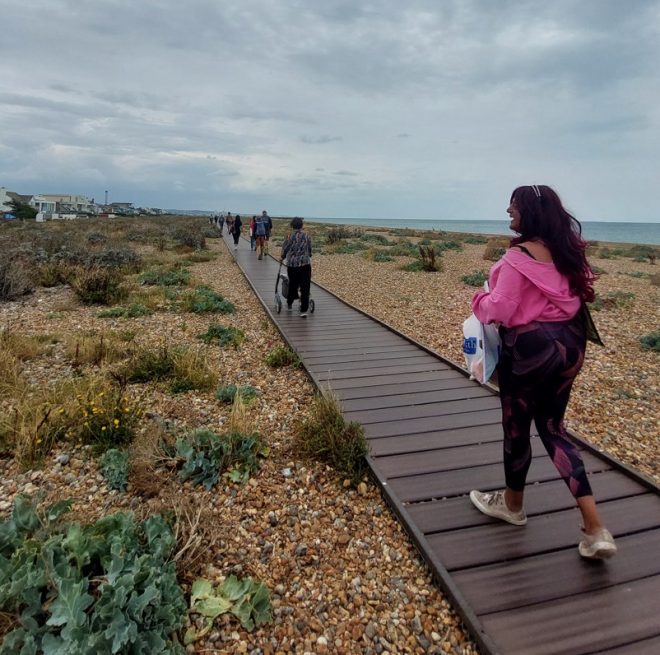
Creative Writing in Stanmer Park
A summer Creative Water Day led another group to the unassuming Stanmer Church Pond. This freshwater habitat offered the occasional glimpse of dragonflies and moorhens, just some of the regular visitors that move between the wildlife ponds across Stanmer Park. Immersing oneself in nature, surrounded by mature trees and the sound of summer, always brings a present sense of rest from pressured lives, of freedom, and of relaxation in good company.
Up on the South Downs at Saddlescombe Farm
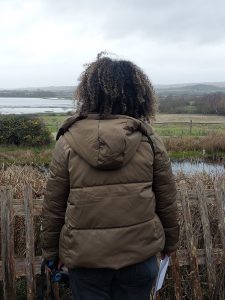 As autumn became winter, our visit to Saddlescombe Farm offered observations of a pond cradled by the South Downs. Resident ducks, wandering guinea foul and sheep grazing nearby share this water with crickets, butterflies and bumblebees. This was the backdrop to peaceful walking, writing and honouring of M’Other Water.
So many questions came to mind. For all our understanding of the paths and fluxes of water through Earth’s ecosystems, did we really appreciate the precariousness of just 2.5% of Earth’s water being freshwater? Water is the life source. How can we lose even one drop?
Dew ponds are a feature across the chalk grassland of the South Downs, with some dug in over several hundred years ago as watering holes for livestock. Was a Saxon farmer here lining a pond with compacted clay or chalk? Do we sense the mystery of those who named these ‘mist ponds’, ‘fog ponds’, ‘cloud ponds’ and ‘sheep ponds’?
More Creative Water Days to Come
Two or three hours never feels quite long enough for the groups that join Writing Our Legacy on their Downs to the Sea creative adventures. This is reflected in comments, which in turn inspire the planning of future events. What is evident is the enjoyment people experience along with the health and wellbeing benefits of being in a community and of enhancing skills and knowledge that encourage the next stage of their writer journeys.
Here is some of the feedback we’ve had:
‘Thank you so much for organising such a magical and informative workshop. Water is such a powerful force to move with and embody. I truly appreciate the love and effort put into enriching our creative lives.’
‘Many thanks for providing such a safe, warm and creative space. Opportunities like this are precious and much appreciated.’
As the programme moves into its second year, Writing Our Legacy will continue to welcome people to walks and Creative Water Days.
New creative commissions and bursaries are soon to be announced, enabling artists to research and create original work inspired by the Downs to the Sea programme. Writers are also being encouraged to reflect upon water in their lives by submitting work for publication in the forthcoming Writing Our Legacy Covert 6 Literary Magazine or by booking a place on a water-themed online writing workshop. For events and other information, please see https://writingourlegacy.org.uk or our social media Instagram or Facebook.
About Downs to the Sea
The £2.4m Downs to the Sea project started last year with ambitious goals of restoring and creating a network of “blue spaces” across the region.
The scheme is supported by a £1.7m grant from The National Lottery Heritage Fund, while Southern Water and DPD are also providing significant additional funding.
In the first year, much-needed improvements have been completed at RSPB Pulborough Brooks and RSPB Pagham Harbour including major habitat restoration, as well as new pathways, viewing platforms and benches to enhance the visitor experience at both destinations.
For more information visit www.southdowns.gov.uk/downs-to-the-sea