
The World of Biofluorescence
Experience the night in a whole new light!
You’d be forgiven for thinking that night-time is dark and nothing can be seen, but the reality is that a wondrous world of biofluorescence is waiting to be discovered.
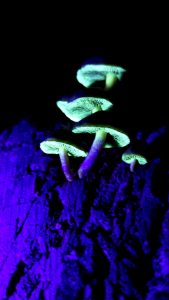
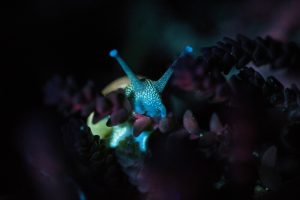
Biofluorescence is the absorption of light at one (usually shorter) wavelength and the emission at a different (usually longer) wavelength, resulting in a different colour light than the original. In the natural world, this usually refers to absorbing ultraviolet light and emitting it in the visible spectrum. There are many species that demonstrate biofluorescence and when lit with an ultraviolet (UV) light, a whole spectrum of vivid colours can be seen. Green lichens become orange, brown mushrooms glow yellow, and even snails and some caterpillars emit their own funky colours!
Top tip – there are lots of different types of UV torches on the market for your own exploration, but the best way to experience the magic of biofluorescence is by joining a guided walk. Check our ‘What’s On’ page for any upcoming events.
Biofluorescence vs bioluminescence
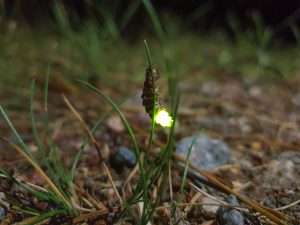
One creature that may be easily overlooked is the glow worm. Despite the name, it isn’t actually a worm – it’s a beetle! The female is the one that glows, producing a tiny light similar to an LED, designed to attract a male. The glowing light is not biofluorescence but bioluminescence, which is when an organism emits its own source of light, instead of emitting light back in another colour.
Glow worms like open grassland or hedges where they can feed on small snails. The females need an open area to display during breeding season from June to August and can often be seen glowing along the edges of footpaths (so it’s always worth watching your step when you’re out exploring on summer evenings!)